
VitalPath will partner with you throughout the product development process. Use our technical knowledge, proprietary processes, and in-house capabilities to bring your product to market effeciently.
Laser Cut Hypotubes
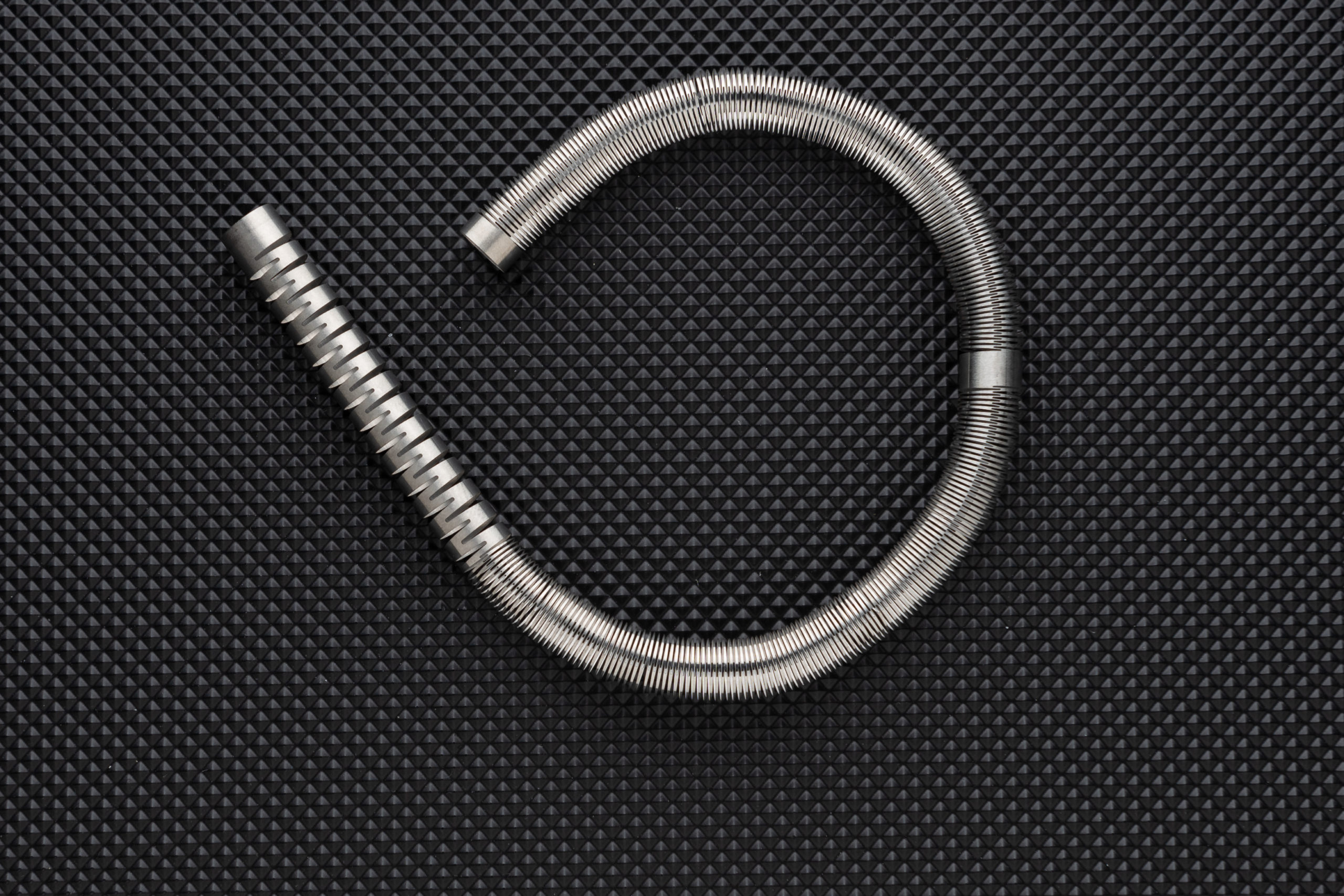
Laser Cut Hypotube Capabilities
Our advanced laser capabilities machine intricate features on miniature components with micron-level accuracy. We leverage state-of-the-art femtosecond laser systems combined with high-speed galvanometric scanner (galvo) turning mirrors. The ultra-fast pulse rate of a femtosecond laser vaporizes material on a microscopic scale, eliminating heat-affected zones (HAZ) and preventing thermal damage, soot, or debris common in traditional lasers.
Nitinol Laser Processing and Fluidized Sand Bath Shape-Setting
For catheter applications requiring flexibility and kink resistance, Nitinol is the material of choice. Its superelasticity and shape-memory properties are ideal for navigating tortuous anatomy. To manufacture Nitinol flexible laser cut hypotubes, we utilize a highly controlled, multi-step workflow:
● Programming: We use SolidWorks to draft patterns and import them into Cagula, converting vectors into precise machine-cutting paths.
● Laser Cutting: Our 5-axis femtosecond lasers maintain exact dimensions and clean inner diameters (ID), leaving a smooth surface with no burrs that could tear internal liners.
● Shape Setting: Nitinol tubes are compressed or expanded over custom fixtures and heat-set in a specialized fluidized sand bath. This bath ensures uniform heat transfer, achieving precise shape-set angles and optimizing active austenite finish (Af) temperatures.
● Electropolishing Compensation: Because electropolishing removes material, our laser programming team compensates for material loss in the code, keeping ultra-fine struts within specification.
Stainless Steel Hypotubes and Continuous Slot Cutting
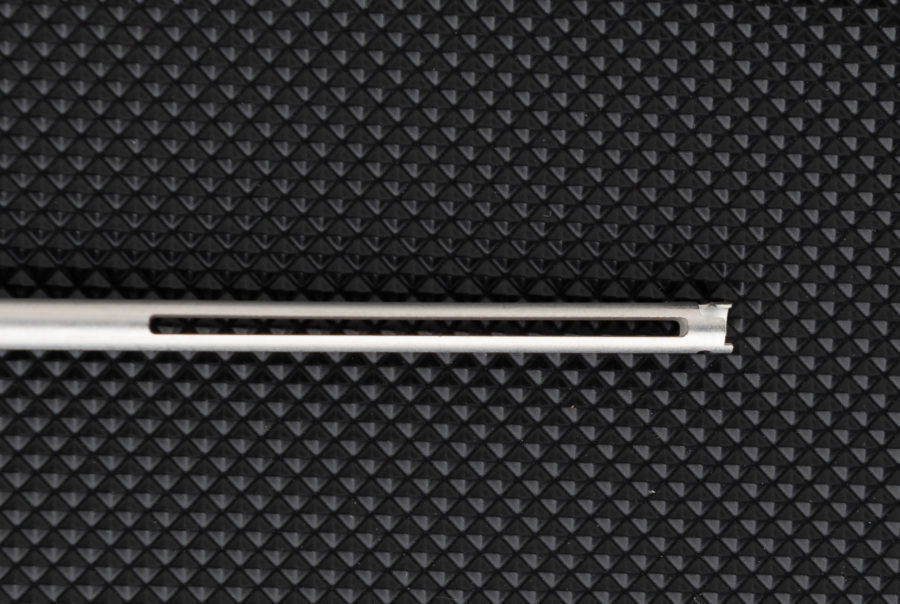
Stainless steel is integrated into the proximal end of a catheter to provide column strength and handle integration. However, cutting continuous slots along the entire length of thin-walled stainless steel tubes is a major manufacturing challenge.
Without proper process controls, internal material stresses cause the tube to dilate, resulting in flaring, jagged edges, and an outer diameter (OD) that fails tolerance requirements. VitalPath overcomes this flaring issue by collaborating with raw material suppliers to control tubing stress states, and by optimizing our laser cutting patterns to reduce internal stresses. This delivers a smooth, linearly aligned slot that actuates with mating handle components without binding or friction.
Design Considerations for Complex Laser-Cut & Welded Components
What’s Inside:
-
Design tips for laser-cut nitinol hypotubes
-
Case studies on integrating structural and functional components
-
Weld optimization insights to ensure integrity under stress
-
Laser ablation and marking techniques to improve precision and manufacturability
-
Polymer laser machining for novel catheter applications
-
Expert recommendations for wire selection, pull rings, and cost-performance tradeoffs
Complete Catheter Integration and Pull Ring Assemblies
For deflectable and steerable catheters, pull ring assemblies drive the axis of motion. VitalPath designs and builds these sub-assemblies in-house, offering three standard pull ring configurations:
- Wire Embedded: Integrated directly within the catheter wall to minimize outer diameter stack-up.
- Outside the Ring: Wire welded on the outside of the pull ring.
- Inside the Pull Ring: Welded inside the ring for specialized deflection profiles.
We work with round and flat high-tensile wires. Wires are typically attached using resistance welding, which preserves 90% to 95% of the wire’s tensile strength. In comparison, standard laser welding can anneal the wire, leading to a 15% to 20% loss of tensile strength that must be designed around. We manage these trade-offs by working with our customers to understand their goals and recommend wire straightness of less than 0.02 inches per foot variance (measured per ASTM F2819) to ensure smooth feedability and robust processing.
Vertically Integrated Secondary Capabilities
To support medical device OEMs with full vertical integration, we provide key in-house polymer laser capabilities:
- Laser Cutting Polymers: Cleanly cut and machine plastics like Pebax, Polyimide, and Polyester films. This is ideal for MRI compatibility and cost-effective prototyping.
- Precision Laser Ablation: Removes polymer jacketing or wire coatings to expose structural reinforcement or electrical conductors (down to ±0.002 inches) eliminating manual errors of mechanical stripping.
- Laser Marking: Provides full-length catheter laser marking on metals and plastics. Laser marks will not smear, require no custom tooling, and can be changed instantly in software. For white materials, adding titanium dioxide to the polymer ensures high-contrast, crisp marks.
Hypotubes | Frequently Asked Questions (FAQ)
Q: What is a hypotube and how is it used in a hypotube catheter?
A: A hypotube is a highly engineered, thin-walled metal tube (typically made of stainless steel or Nitinol) that serves as the structural foundation of a catheter. When integrated into a hypotube catheter, it provides the pushability, torque response, and kink resistance necessary to safely navigate the vascular system.
Q: Why should I work with integrated hypotube manufacturers rather than component-only vendors?
A: Component-only vendors deliver parts without understanding how they interface with liners, braids, or jackets. Partnering with full-service hypotube manufacturers like VitalPath ensures your metal components are optimized for reflow, tipping, and assembly, eliminating scaling delays.
Q: What are VitalPath’s primary laser cut hypotube capabilities?
A: Our laser cut hypotube capabilities include 5-axis femtosecond laser cutting of stainless steel and Nitinol, continuous slot cutting, custom pitch/spiral patterns, micro-machining of sharp points, fluidized sand bath heat-setting, and dimensional path compensation for electropolishing.
Q: How do flexible laser cut hypotubes improve catheter navigation?
A: By laser cutting precise patterns—such as interrupted slots, spiral cuts, or interlocking joints—we transform rigid metal tubing into highly flexible laser cut hypotubes. These patterns allow engineers to customize the bend radius and stiffness transitions along the shaft, giving physicians tactile, predictable control.
Q: How does VitalPath address flaring during hypotube laser cutting?
A: During long, continuous hypotube laser cutting runs, internal stresses can cause thin-walled materials to dilate. VitalPath avoids this flaring by partnering with raw material suppliers to control tubing stress states and by utilizing optimized, stress-relieving laser cutting paths.
Q: What materials are supported in your hypo tubing manufacturing processes?
A: Our hypo tubing manufacturing processes support stainless steel, Nitinol, titanium, and high-performance polymers such as polyimide, Pebax, and polyester films.
Q: What are the advantages of choosing a partner with in-house laser cut hypotube solutions?
A: In-house laser cut hypotube solutions combined with catheter assembly eliminate logistical delays and accelerate prototype turnarounds. Early NPI alignment ensures patterns designed in R&D are robustly scalable, avoiding costly post-design-freeze modifications.
Q: Why is laser cutting hypotubes superior to mechanical cutting methods?
A: Laser cutting hypotubes with femtosecond lasers is a non-contact process preventing physical deformation. It allows for tight cut widths (to 0.001 inches), complex geometries, and clean edges that do not require aggressive acid cleaning.
Q: What should OEMs look for when selecting a partner for hypotube manufacturing?
A: OEMs should select a partner with ISO 13485-2016 certification, advanced measurement systems, vertical integration, and a robust Product Development Process (PDP) that scales from prototype to production.
Q: How does VitalPath support high-complexity laser cut hypo tubes?
A: We specialize in the “toughest challenges”. Whether your design requires ultra-thin walls, multi-directional deflection, micro-scale laser welds, or complex Nitinol shape-setting, we deliver highly customized laser cut hypo tubes designed for repeatable, high-yield manufacturing.
Q: Can your laser cut hypo tube capabilities support microcatheters?
A: Yes, our advanced laser cut hypo tube processes can handle miniature profiles down to neurovascular sizes (under 3 French) with precise laser-cut patterns and tight tolerances, perfect for access and delivery in small anatomies.
Q: Does VitalPath hold ISO certifications for catheter manufacturing?
A: Yes, VitalPath is fully ISO 13485-2016 certified across all three of our Minnesota-based centers of excellence in New Hope, Maplewood, and Cokato, ensuring world-class quality controls for your catheter manufacturing programs.
